
Going home after a hospital stay is often a welcome milestone, but for older adults and people living with complex health needs, the days and weeks that follow discharge can be a vulnerable time.
Patients may still need support, help managing medications, assistance with daily activities, or follow-up to make sure they continue their recovery. But knowing which patients may need additional support after discharge can be challenging.
A new study from Kingston Health Sciences Centre (KHSC) and the Smith School of Business at Queen’s University suggests the information may already be contained in a patient’s health-care record. That data could help medical teams predict which patients may be at greater risk of returning to hospital after discharge — potentially allowing them to provide support before a problem becomes an emergency.
"For many patients, home is the best place to recover when it is safe to do so," says Jason Hann, Executive Vice President of Patient Care and Chief Nursing Executive at KHSC. "This study demonstrates how data already available within the health-care system can help. Combined with clinical judgment, these insights can help us better tailor care and services to individual patient needs."
Bringing hospital care home
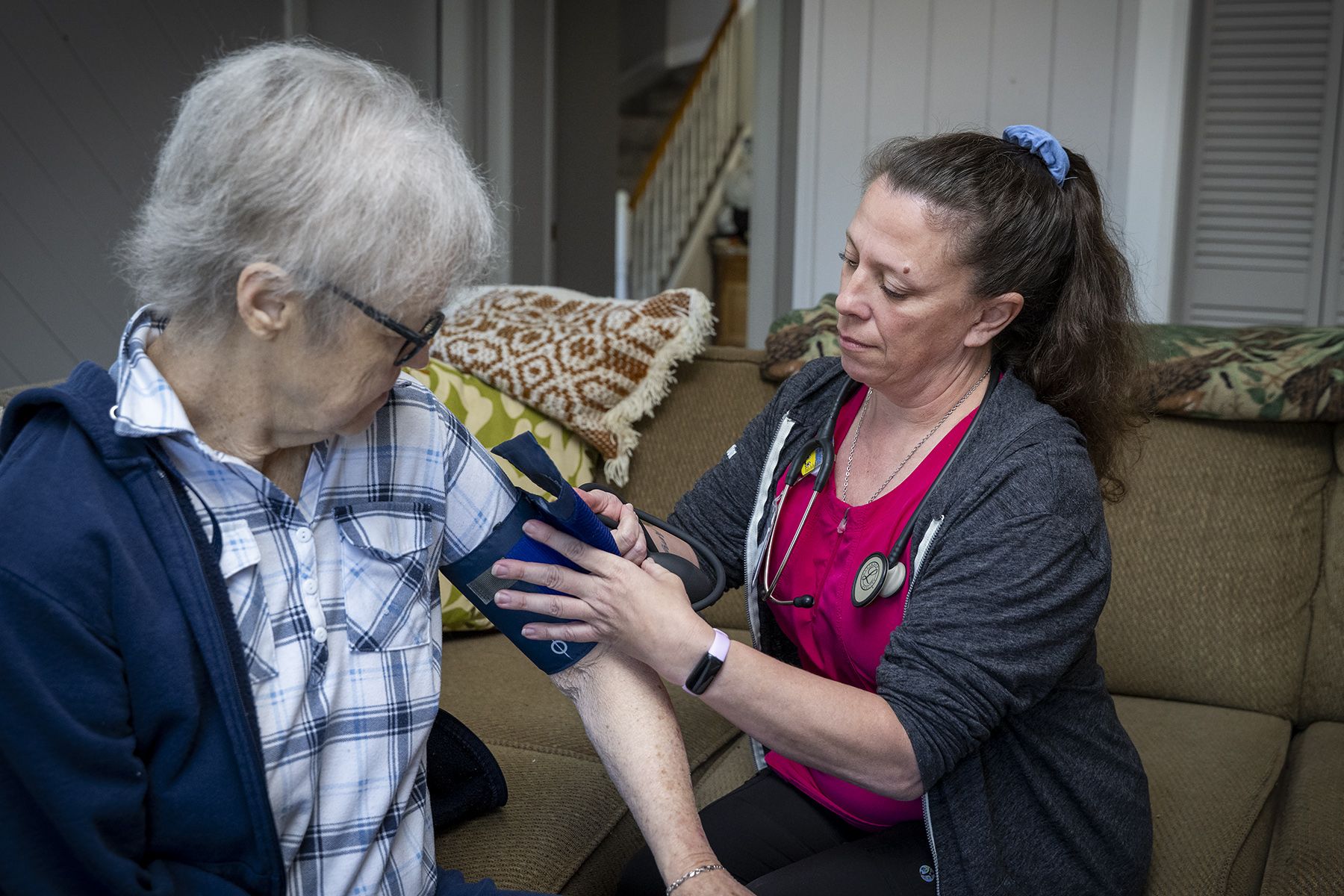
KHSC@Home is one of 12 integrated home and community care programs offered through KHSC. The program brings hospital expertise into patients’ homes while working with primary care providers and community organizations to coordinate care. Last year, approximately 800 patients were enrolled in KHSC@Home.
Instead of spending additional days in a hospital bed, eligible patients receive coordinated clinical and community support in their own home. Care teams work together to make the transition from hospital to home as safe and seamless as possible.
For patients, that can mean recovering in a familiar environment, surrounded by the people and routines that matter to them. It can also help make hospital beds available for other patients who need hospital-based care.
But providing care at home is only part of the challenge. Health-care teams also need to know which patients would benefit most from additional support, and which may be at greater risk of returning to hospital after discharge.
Looking at patient data to predict future needs
The study examined five years of KHSC@Home patient data, from May 2020 to May 2025. They combined information about patients’ care through KHSC@Home with records of their previous emergency department visits and hospital admissions.
The question was straightforward: Could information already available in a patient’s health-care record help identify people who might be at greater risk of returning to hospital?
The findings suggest it can.
A patient’s recent history of using health-care services was a stronger predictor of future hospital use than their health conditions alone.
For example, someone who has visited the emergency department several times, has been admitted to hospital recently or had frequent health-care encounters may need more support after going home — even if the current reason for their admission appears straightforward and not particularly concerning on its own.
The study also found that most KHSC@Home patients in fact did not return to hospital during the periods studied. Three per cent of patients returned to hospital within 30 days, while 7.1 per cent returned within 90 days.
Matching care to the patient
Predictive analytics in health care is not intended to replace the judgment of doctors, nurses or other health-care professionals. Instead, it can provide care teams with another tool to help identify patients who may need additional attention or more care after discharge.
“That may mean for two patients with similar reasons for hospital admissions, one patient may only require routine follow-up. For another, it could mean greater services in the home and frequent contact with a care team,” says Thomas Hart, Executive Director of Patient Care and Deputy Chief Nurse at KHSC. “The aim is to match the level of care to the patient’s needs based on a comprehensive view of their health history, rather than the most recent hospital admission or just treating every patient the same.”
While the study focused on KHSC@Home, the approach may have broader applications across hospital-at-home, virtual care, transitional care and other community-based programs.
For KHSC, the work contributes to a broader shift in how health care can be delivered, recognizing that a hospital is not always the best place for someone to receive care. Ultimately, the goal is not simply to keep people out of hospital. It is to help ensure patients receive the right care, in the right place, at the right time.